
For service businesses—from hair salons, dental clinics, and spas to auto detailing studios, consultancies, and specialty trades—customer trust is the primary driver of revenue.
A business can invest thousands of dollars into advertising, branding, and prime street locations. Yet when a prospective client is deciding between two providers, their choice almost always comes down to recent Google reviews and authentic word-of-mouth.
Despite this, collecting reviews on autopilot is one of the most common operational bottlenecks:
- Happy customers leave silently: A customer has a great experience, pays at the front desk, walks out the door, and completely forgets to write a review once they get home.
- Unhappy customers voice frustration publicly: An isolated misunderstanding or a 15-minute wait prompts a dissatisfied customer to vent on Google or Facebook with a damaging 1-star rating before management even knows something went wrong.
- Email requests get ignored: Sending an automated email a day or two later saying "Please rate us on Google" lands in the Promotions tab or gets deleted unread.
When we built Pillar 2: The Reputation Engine at Patofy (as part of our Four R's framework: Reception, Reputation, Retention, and Referrals), our goal was to eliminate this friction by engaging customers directly on WhatsApp, where they already communicate with the business.
This post covers both sides of the system: how the post-service check-in experience works for business owners and their clients, and how we engineered the underlying two-way sentiment routing, anti-fatigue safeguards, and Edge-rendered social proof cards.
1. Why Post-Service WhatsApp Check-Ins Beat Email Review Requests#
Traditional review collection workflows suffer from two fundamental problems: wrong channel and wrong timing.
| Channel Metric | Post-Visit Email Blast | Two-Way WhatsApp Check-In |
|---|---|---|
| Open Rate | 12% – 18% (frequently filtered) | 95%+ (typically read within minutes) |
| Customer Friction | Multiple browser clicks and login hops | Native mobile chat; zero login barrier |
| Delivery Timing | Batched 24–48 hours after the visit | Sent 1–2 hours after service completion |
| Message Cost | Monthly email platform fee | Often $0 (rides inside the active 24hr booking window) |
| Tone | Impersonal broadcast marketing | Polite, one-to-one check-in |
| Response Rate | Often under 3% | 25% – 38% direct reply rate |
When an email arrives two days later, the immediate satisfaction of a fresh haircut, a pristine car detail, or an insightful consultation has cooled down. The customer has moved on with their week.
On WhatsApp, a brief message 1 to 2 hours after the service is completed catches the customer while their positive impression is still fresh. Even better, because most clients interacted with an appointment confirmation or reminder on WhatsApp earlier that day, this post-visit check-in typically falls inside Meta's free 24-hour customer service window.
2. The Two-Way Sentiment Gate & Dispute Dampener#
A naive review automation tool sends every customer the exact same public review link right away:
"Thanks for visiting today! Please leave us a review on Google: https://g.page/..."
This is a major risk for a service business. If a customer had a frustrating experience, sending them a direct public review link is an invitation to post a permanent 1-star rating online before anyone on your team knows there was an issue.
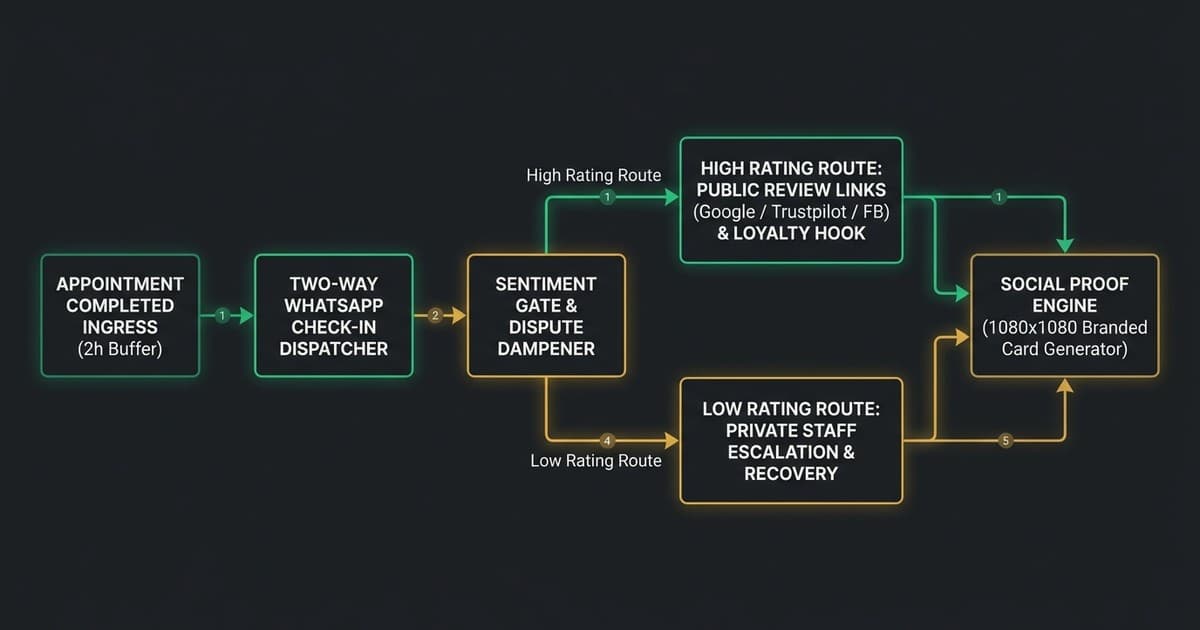
To protect business reputation while encouraging happy clients to share their praise publicly, Patofy uses a Two-Way Conversational Sentiment Gate:
Step 1: The 1–2 Hour Post-Visit Check-In#
Roughly 90 minutes after an appointment is marked complete, Patofy sends a personal check-in that mentions the team member who served the client:
"Hi Sarah! Thank you for visiting Sifmax Beauty Parlour today with Grace. On a quick scale of 1 to 5, how was your experience with us today?"
Step 2A: The Positive Sentiment Branch (4–5 Stars)#
When Sarah replies with a 4 or 5 (or sends a glowing message about her visit):
-
Conversational Gratitude & Public Link: The assistant thanks her warmly and invites her to share her experience publicly:
"We're so glad you loved your visit, Sarah! We'll be sure to pass your kind words to Grace. If you have 20 seconds, would you mind sharing your experience on our Google page? It helps our team enormously: [Google Review Link]"
-
Loyalty Recognition: If the business has a rewards program enabled, the customer's account is credited with loyalty points as an immediate thank-you for sharing feedback.
-
The Referral Connection: Delight is contagious. When sentiment is at its peak, the system can introduce the business's referral program, giving happy clients a personal invite link to share with friends and colleagues.
Step 2B: The Dispute Dampening Branch (1–3 Stars)#
When a customer indicates dissatisfaction or a problem:
-
Private Listening Instead of a Public Link: Rather than pushing an upset client toward Google Maps, the assistant responds with immediate empathy:
"We are so sorry to hear that things didn't go as expected today. Your satisfaction is our top priority. Could you let us know what happened so our management team can resolve this for you right away?"
-
Internal Escalation: The engine flags the conversation as an urgent follow-up task on the manager's dashboard, notifying leadership with the customer's notes, service history, and contact details.
-
Private Resolution: A manager or business owner can review the issue and reach out personally within minutes to listen, apologize, and make things right.
By resolving misunderstandings privately in a supportive chat, businesses turn potential 1-star public reviews into retained, loyal customers.
3. Queue Pacing & Anti-Fatigue Safeguards#
Sending automated review outreach requires discipline. Blasting review requests in sudden bursts introduces two major risks:
- Platform Spam Filters: If a business usually receives three reviews a month and suddenly gets 30 reviews in one afternoon, review platforms can flag the sudden spike as suspicious, leading to legitimate reviews being filtered or delayed.
- Customer Messaging Fatigue: Regular clients who visit weekly or bi-weekly should not be asked for a review after every single appointment.
To keep outreach natural and respectful, Patofy's review queue enforces three safeguards:
1. Paced Daily Dispatch#
Outbound requests are metered throughout the week according to the business's daily sending preferences. This maintains a steady, organic trickle of reviews over time rather than artificial bursts that trigger anti-spam flags.
2. 30-Day Anti-Fatigue Cooldown Window#
If a customer has already received a review check-in within the last 30 days, any new check-in request for that contact is automatically skipped. Regular clients enjoy the service without feeling bombarded by automated surveys.
3. Team Member Attribution#
Connecting feedback to the specific stylist, clinician, or technician who delivered the service gives business owners clear visibility into customer satisfaction across their entire staff.
4. Why Verifying Public Reviews Automatically Is a Myth#
Business owners often ask:
"Can the software check whether the customer actually went to Google, typed out a review, and clicked 'Publish' before awarding them reward points?"
From a technical and policy perspective, the answer is no—and any software claiming otherwise is either misleading you or violating platform rules.
The Technical & Policy Boundaries#
- No Public Consumer Webhooks: Review platforms like Google Business Profile and Meta do not provide webhooks that report "Customer Jane Doe just published a 5-star review via WhatsApp." Programmatic verification would require every customer to grant an external app OAuth access to their personal Google account—something ordinary customers will never do.
- Public Usernames Don't Match Phone Numbers: Public display names (such as "Alex M.") cannot be matched reliably to private customer telephone numbers.
- Anti-Incentivization Policies: Major review platforms strictly prohibit offering cash, discounts, or conditional rewards in direct exchange for positive public reviews (quid-pro-quo review gating).
The Pragmatic Solution: Rewarding Direct First-Party Feedback#
Instead of fighting platform constraints, our architecture takes a practical approach:
- We reward the customer for their verified first-party feedback inside WhatsApp.
- When a customer rates their experience 5 stars and writes a positive note in the chat, they have already demonstrated high loyalty and provided valuable feedback to the business.
- Because they already typed their compliment in WhatsApp, copying and pasting that exact text to Google takes a single tap.
5. Turning Private Chat Compliments into Branded Social Proof#
Even when busy customers don't post to Google, they often text glowing messages directly in WhatsApp:
"The team did a fantastic job with my car today! The interior looks brand new, and they finished 30 minutes ahead of schedule. Truly top-notch service."
In day-to-day operations, these testimonials stay trapped inside private chat threads. Staff read them, appreciate them, and the message gets pushed down by new incoming chats.
To help businesses turn these private compliments into marketing assets, Patofy includes a Dynamic Social Proof Generator.
Instead of spinning up slow, memory-hungry headless browsers (like Puppeteer or Playwright) to capture screenshots, social proof cards are rendered on-the-fly on the Edge using Next.js ImageResponse with Satori.
The engine converts JSX directly into vector paths and outputs high-resolution 1080×1080 PNG images in under 400ms. It formats the customer's testimonial into an authentic WhatsApp chat bubble, protects privacy by using first name and last initial, and accents the card with the business's official logo, brand colors, and star ratings. Team members can download ready-to-post cards with a single click from their dashboard to share on Instagram Stories, Facebook, or WhatsApp Status.
6. Under the Hood: System Flow and State Transitions#
For engineers and technical founders looking at how this operates across simultaneous business tenants in Payload CMS and MongoDB, each check-in lifecycle is governed by a deterministic FeedbackSession state machine:
// Multi-Tenant Feedback Session State
interface FeedbackSession {
  tenantId: string;
  customerId: string;
  serviceRecordId?: string;
  staffAttributionId?: string;
  status: "queued" | "dispatched" | "responded" | "escalated" | "resolved";
  rating?: 1 | 2 | 3 | 4 | 5;
  feedbackText?: string;
  sentimentRoute: "public_review_invite" | "private_escalation" | "pending";
  cooldownExpiresAt: string; // Enforces 30-day anti-fatigue window per customer
  lastDispatchedAt?: number;
}
- Service Ingress: Once a service is marked complete, a delayed queue item is scheduled with a 1–2 hour cooldown buffer.
- Paced Outbound Delivery: The queue worker verifies that the customer hasn't received a request in the past 30 days and confirms that the organization is within its daily send quota.
- Sentiment Routing:
- Positive Ratings (4–5 stars): The engine delivers the public review link, credits reward points, and invites the customer to share their referral link with friends.
- Constructive Ratings (1–3 stars): The engine routes the reply to private feedback capture and creates a high-priority follow-up alert in the team dashboard.
- One-Click Social Proof: Verified compliments can be exported as branded 1080×1080 social graphics in under 400ms, keeping marketing feeds active with real customer praise.
Building Compounding Trust on Autopilot#
A reputation strategy that depends entirely on customers remembering to post reviews on their own will always move slowly.
By meeting customers on WhatsApp 1 to 2 hours after their appointment, you reach them where open rates exceed 95%, catch grievances privately before they become public 1-star reviews, enforce respectful 30-day cooldowns, and turn everyday chat compliments into ready-to-share social media assets.
Related Patofy Guides & Engineering Deep Dives#
- 👉 Pillar 1 (24/7 Front Desk): Architecting a WhatsApp AI Receptionist: Multi-Turn Memory, 24hr Conversation Windows, and Fail-Safe Human Handoff
- 👉 Pillar 3 (Client Win-Backs): How to Revive Dormant Clients on WhatsApp
- 👉 Platform Infrastructure: Ditching Vercel for a $15 Hetzner Server with Dokploy
- 👉 The Full Case Study: Patofy Engineering & Product Architecture Case Study
Looking to automate your business's customer reviews, client retention, and WhatsApp bookings? Connect with me directly at jackmkimbo.com/#contact or learn more at patofy.com.