
Most conversational AI tutorials share an identical blueprint: ingest a few PDF documents into a vector database, write a basic prompt with sliding-window chat history, give the model two or three CRUD tools, and launch a chatbot.
If you are building an internal company wiki search or an e-commerce return policy assistant, that generic blueprint works adequately well.
The moment you deploy that exact same architecture into complex, fast-moving, and highly constrained domains—such as live sports analytics, financial portfolio intelligence, or multi-facility logistics—the system breaks down almost immediately.
In high-context, real-time domains:
- Information has an aggressive time-decay curve: what was factually true forty-eight hours ago may be completely invalid today.
- Entity density per turn is massive: conversations involve dozens of interconnected entities, rolling schedules, and regulatory or rulebook boundaries.
- Users explore hypothetical scenarios alongside persistent realities, requiring distinct tiers of state management.
Building Panda FPL reinforced a fundamental principle of systems architecture: you cannot build domain-agnostic agents for domain-specific problems.
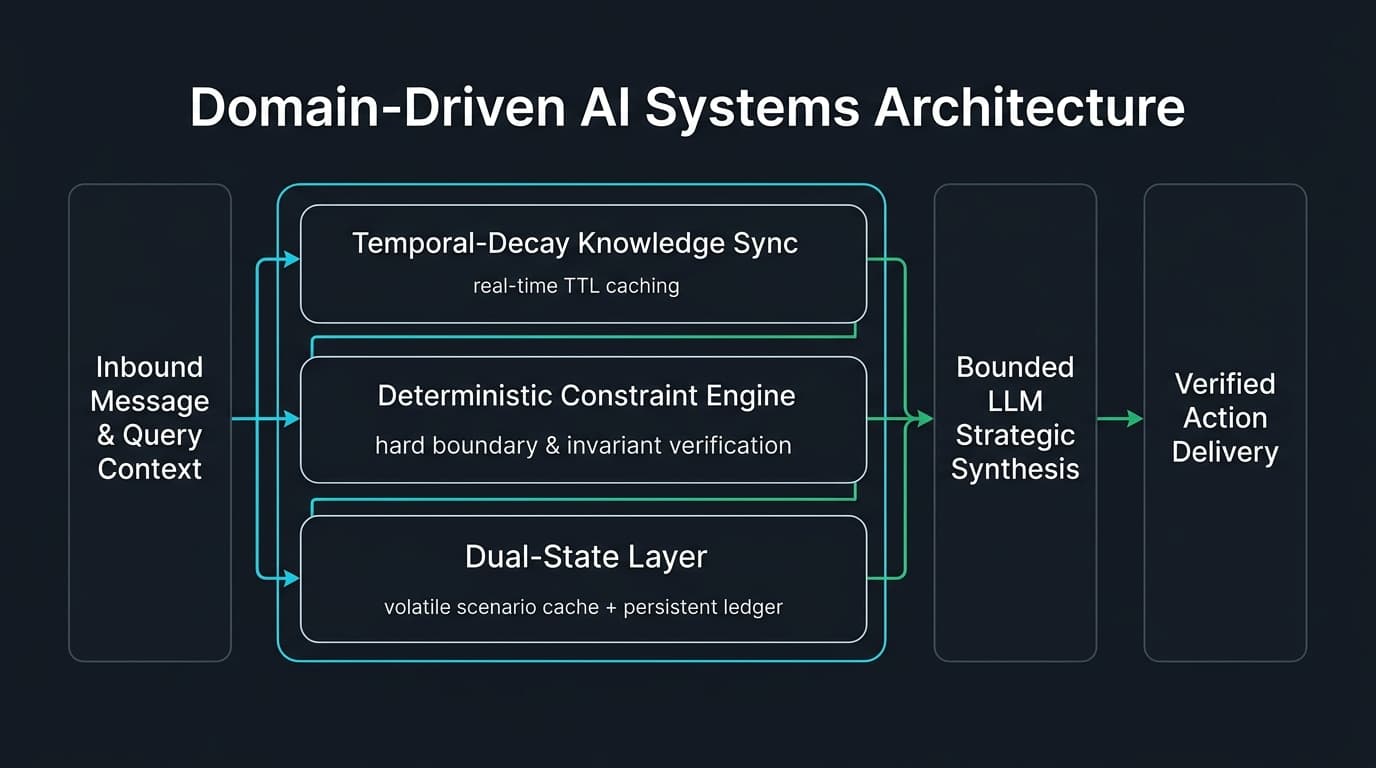
Here is an architectural framework examining how RAG, context engineering, tool design, and session memory must fundamentally adapt when engineering AI systems for specialized, real-time environments.
The Four Architecture Pillars Across Domains#
To see why a single architectural pattern cannot serve every use case, consider how core system requirements diverge across four distinct production environments:
| Engineering Dimension | Standard Support & Knowledge Base | E-Commerce & Retail Catalogs | Fast-Moving Sports & Live Events | Regulated Legal & Compliance |
|---|---|---|---|---|
| RAG Strategy | Static Chunking: Evergreen policies, FAQs, documentation. | Attribute Filtering: Product specs, pricing, inventory flags. | Temporal-Decay Hybrid: Static rulebooks paired with fast-expiring real-time status. | Strict Verbatim: Deterministic retrieval with cryptographic audit citations. |
| Context Density | Low: user question and isolated answer chunks. | Moderate: cart items, search filters, category breadcrumbs. | Extreme: 15-player squads, 20 club schedules, bank balances, price swings. | High: multi-page contracts, clauses, cross-statute references. |
| Tool Execution | Basic CRUD: fetch policy, log ticket, send confirmation. | Transactional: check inventory, apply coupon, initiate checkout. | Combinatorial Solvers: Knapsack budget optimization, mathematical heuristics. | Rule Validators: compliance checkers, clause comparison. |
| Session Memory | Short-lived: single-session ticket resolution. | Medium-lived: browsing history, abandoned carts. | Two-Tier Volatile: Persistent user history overlaid with ephemeral mid-week state. | Long-term: immutable legal audit trail. |
1. Static Knowledge RAG vs. Fast-Decaying Temporal RAG#
In traditional document search, semantic cosine similarity over chunked text is the gold standard. A human asks about an employee expense policy, the system fetches the three most similar paragraphs from a handbook written six months ago, and the LLM synthesizes an accurate answer.
In fast-moving domains, standard semantic similarity is actively dangerous.
Consider a sports assistant responding to: "Is Hinshelwood a good pick this weekend?"
- If the vector store retrieves an article from Gameweek 1 praising his two-goal haul and 16.0 points-per-game record, pure cosine similarity ranks it as a 0.94 relevance match.
- But if the player suffered an injury in Gameweek 2, missed four consecutive matches, and only just returned to training, that high-scoring vector match is obsolete.
In dynamic domains, retrieval must combine dense semantic embeddings with temporal decay weighting and hard relational state filters:
Final Relevance Score = Cosine Similarity × Exponential Decay Factor × Availability Guard
Here, the Exponential Decay Factor penalizes information as time elapses since publication, while the Availability Guard programmatically zeros out relevance if current relational status flags mark the entity as injured, suspended, or unconfirmed.
2. Managing Extreme Entity Density Without Context Saturation#
In a standard customer service bot, the context window contains the user’s message and perhaps an order number.
In complex domains like sports, finance, or supply chains, the operational entity density is staggering. A single user inquiry may implicitly depend on:
- The user’s complete 15-man active roster and bench hierarchy.
- Their current bank balance, active chip availability, and rolled transfer count.
- Upcoming multi-week fixture schedules for twenty distinct clubs.
- Real-time league standings and points margins against mini-league rivals.
If you dump all of this raw data into the LLM context window, you consume thousands of tokens on every message turn, drive up operational costs, and cause the model to suffer from the lost-in-the-middle phenomenon—confusing bench players with active starters or hallucinating opponent difficulty.
Positional Slicing and Context Masking#
Rather than passing monolithic payloads, the system must employ dynamic context pruning:
- When the user asks about attacking options, defensive rosters and goalkeeper records are stripped out before context injection.
- When the query is an account balance check, match fixtures are omitted entirely.
By isolating only the entity slice strictly necessary for the immediate reasoning turn, input tokens drop by over 60%, inference latency drops to sub-3 seconds, and positional confusion is eliminated.
3. Tool Architecture with LLM Reasoning and Deterministic Solvers#
In simple web applications, tools act as straightforward wrappers around REST APIs: the LLM extracts arguments and calls POST /api/bookings.
In constrained operational domains, an LLM should never be permitted to calculate the solution directly.
Whether optimizing an investment portfolio under risk-exposure ceilings, planning flight crew scheduling under FAA rest mandates, or drafting an optimal fantasy squad under a strict budget cap, the problem is a combinatorial mathematical challenge.
If you ask a language model to select candidates under a £101.2m budget limit, it will routinely spend £103.5m, hallucinate asset prices, or select four players from the same club.
The correct architectural boundary:
- The LLM is the Strategic Orchestrator: It understands user intent, reads qualitative signals, interprets team news, and formulates high-level tactical goals.
- The Deterministic Solver is the Calculator: It receives constraints, runs knapsack or linear programming algorithms, enforces hard invariants, and returns mathematically guaranteed outputs.
4. Session State with Persistent Records and Volatile Overlays#
In transactional e-commerce or customer support, user state is linear and persistent: a customer orders an item, receives a confirmation, and their account balance updates permanently.
In analytical and strategic domains, users constantly explore hypothetical branches:
- "What if I sell my top forward for two budget midfielders?"
- "Show me what my team looks like on a Free Hit."
- "I just made a transfer in the official app, update my squad."
If the system commits these changes directly to the primary database, the user’s verified profile becomes corrupted with unconfirmed scenarios. If the system ignores them, subsequent conversational turns produce jarring dissonance.
// Conceptual Multi-Tier State Interface
interface UserStateSession {
  userId: string;
  // Permanent ground truth synchronized from official APIs
  persistentBaseline: {
    verifiedRoster: string[];
    officialBank: number;
    syncedAt: string;
  };
  // Ephemeral mid-week overlay for out-of-band human mutations
  volatileOverlay?: {
    activeGameweek: number;
    hypotheticalRoster: string[];
    simulatedBank: number;
    expiresAt: string;
  };
}
By decoupling state into a persistent ground-truth baseline and an ephemeral volatile overlay, the agent seamlessly reasons over the user’s hypothetical mutations while automatically resetting to official records the moment real-world deadlines expire.
The Strategic Takeaway#
Building high-performance AI agents is not about finding a single universal framework. It is about understanding the structural properties of your domain:
- If knowledge changes hourly, build temporal-decay RAG, not static vector stores.
- If entity density is high, prune context dynamically instead of feeding raw database tables.
- If boundaries are mathematically rigid, delegate execution to deterministic solvers instead of expecting LLMs to count.
- If user exploration is hypothetical, isolate volatile session state from ground-truth ledgers.
When your architecture mirrors the actual constraints of the domain, you transform conversational AI from an unreliable prototype into an institutional-grade decision engine.
Related Deep Dives in This Series#
- Part 1 — Behind the Multi-Agent Architecture of Panda FPL
- Part 2 — How Consolidating 22 Tools into 5 Fixed Our Agent Hallucinations
- Part 4 — Engineering Sub-10-Second Tactical AI on WhatsApp
- Part 5 — Preventing Runaway LLM Costs with Atomic Credit Metering
- Case Study — Panda FPL Systems Architecture Case Study
Architecting specialized domain-driven AI agents, optimizing real-time RAG pipelines, or integrating deterministic solvers? Let's discuss your system architecture at jackmkimbo.com/#contact.