
Building a conversational AI demo in a web playground is relatively forgiving.
When a user submits a prompt in a browser chat interface, they are accustomed to watching a streaming cursor pulse across the screen for 10 to 15 seconds while multiple tools execute in the background. Visual skeletons, progress spinners, and token streams provide continuous feedback that the system is working.
On WhatsApp, the rules of engagement are brutally different.
WhatsApp does not support streaming token responses via its Cloud API. When a user sends a query, there is no progressive text rendering. If your system takes 12 seconds to respond without immediate feedback, the user assumes the bot crashed, sends a follow-up question, or closes the app in frustration.
Furthermore, real users do not interact in sterile, isolated turns. A passionate fantasy sports manager will fire off three fragmented texts in four seconds, follow it with a 20-second voice note recorded in traffic, and expect an elite, data-grounded tactical squad audit before their private mini-league deadline closes.
When building Panda FPL—our autonomous Fantasy Premier League strategist serving managers across the globe—our benchmark was clear: deliver deep, multi-tool tactical intelligence in sub-10 seconds while handling the chaotic realities of live messaging.
In this technical breakdown, I examine the production architecture behind Panda FPL’s real-time engine: from timing-safe webhook verification and in-memory multimodal voice note ingress to distributed debounce locks, context-pruning squad masks, and resilient model waterfalls.
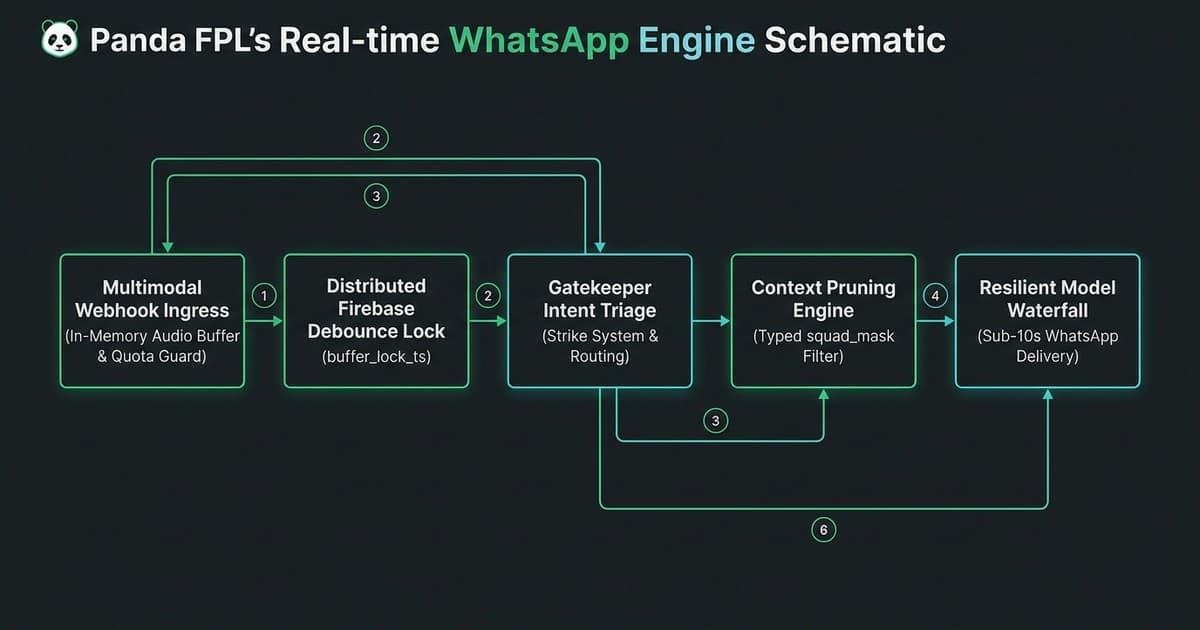
1. The Anatomy of a Sub-10s Latency Budget#
To appreciate why sub-10-second end-to-end execution is an engineering challenge, consider what must happen between the millisecond a WhatsApp webhook hits your server and the millisecond Meta delivers the final response:
When you inspect this pipeline, claiming sub-3-second responses in a multi-tool autonomous agent environment is unrealistic.
Between downloading voice notes, executing external sports data fetches, running RAG lookups, and invoking reasoning LLMs, raw compute time adds up. However, by decoupling instant perceptual responsiveness (sub-200ms markReadAndTyping acknowledgments) from asynchronous tool execution, sub-10-second total turnaround feels lightning fast to the end user.
2. Ingress Security with Timing-Safe HMAC Verification#
Before a webhook payload can touch our debounce layer or trigger compute, it must pass cryptographic verification. Any publicly exposed webhook endpoint is a target for denial-of-wallet attacks: bad actors can flood your endpoint with spoofed payloads, triggering expensive LLM runs and burning API credits.
Meta signs all inbound webhooks using an HMAC-SHA256 signature passed in the x-hub-signature-256 header. Validating this signature sounds simple, but production frameworks introduce two critical pitfalls:
- Body Parsing Invalidation: If your Next.js route parses
await req.json()before checking the signature, subtle JSON re-serialization differences (whitespace, key ordering) will cause the computed hash to diverge from Meta's original hash. Verification must always run against the raw UTF-8 string or buffer. - Timing Attacks: Standard string comparisons (
computedHash === signature) exit early on the first mismatched character, creating a side-channel timing attack. Production implementations must use constant-time comparisons (crypto.timingSafeEqual).
import crypto from "crypto";

export async function verifyMetaSignature(
  req: Request,
  rawBody: string,
): Promise<boolean> {
  const appSecret = process.env.WHATSAPP_APP_SECRET;
  if (!appSecret) return true; // Safe development fallback

  const signatureHeader = req.headers.get("x-hub-signature-256");
  if (!signatureHeader || !signatureHeader.startsWith("sha256=")) {
    return false;
  }

  const signature = signatureHeader.substring(7);
  const expectedSignature = crypto
    .createHmac("sha256", appSecret)
    .update(rawBody, "utf-8")
    .digest("hex");

  const signatureBuffer = Buffer.from(signature, "hex");
  const expectedBuffer = Buffer.from(expectedSignature, "hex");

  if (signatureBuffer.length !== expectedBuffer.length) {
    return false;
  }

  return crypto.timingSafeEqual(signatureBuffer, expectedBuffer);
}
By reading the raw text once with await req.text() and verifying the HMAC before any parsing occurs, we reject unauthorized or forged payloads at the edge in sub-millisecond time.
3. Multimodal Ingress with In-Memory Voice Notes and Quota Guards#
A significant percentage of users prefer sending voice notes over typing long essays on mobile keyboards. But handling audio in a high-throughput webhook environment introduces severe architectural traps:
The Disk Leak Trap#
Writing uploaded audio files to temporary disk storage (/tmp) on ephemeral cloud containers or serverless functions creates memory leaks, race conditions under concurrent traffic, and security vulnerabilities.
The In-Memory Streaming Pattern#
In Panda FPL, inbound audio payloads never touch physical disk storage. When Meta's webhook alerts our gateway to an audio attachment:
- Upfront Duration Guard: The gateway validates that the audio duration is under 30 seconds. Anything longer is rejected immediately to protect multimodal compute budgets.
- In-Memory Buffer Streaming: The binary
.oggmedia payload is fetched over an authenticated TLS stream and buffered directly into memory. - Zero-Disk Multimodal Transcription: The raw buffer and MIME type are streamed directly to the multimodal model API for inline transcription, returning the parsed text query in a single round-trip.
- Usage Tracking: Every user profile maintains tracked daily and weekly voice note counters. Once a user reaches their tier allowance, the agent gracefully informs them and prompts them to continue via text, safeguarding operating margins.
4. Distributed Debounce with Timestamp Concurrency Locks#
One of the most pervasive bugs in messaging-based AI systems is message fragmentation.
When an FPL manager is making decisions on Friday night, they rarely write one consolidated paragraph. Instead, their thoughts arrive in rapid succession:
- 10:01:02 PM: "Should I sell Saka for Palmer?"
- 10:01:04 PM: "Or take a -4 hit for Isak?"
- 10:01:06 PM: "I have 0.8 in the bank"
If your webhook gateway treats each message as an independent event, it spawns three parallel agent executions. The pipelines race against each other, consume triple the token credits, and return three contradictory pieces of advice within seconds.
The Distributed Concurrency Lock#
To solve this, we implemented a distributed debounce buffer backed by Firebase Realtime Database. When a webhook arrives:
- The message text is appended to an atomic
input_bufferarray under the user's session key. - The system assigns a unique timestamp (
buffer_lock_ts = Date.now()) and pauses for a 1,500ms debounce window. - When the timer elapses, the worker inspects the database snapshot. If a newer incoming message updated
buffer_lock_tsduring the sleep window, the current worker gracefully terminates, deferring to the newer process. - The worker holding the matching timestamp flushes the entire accumulated buffer, concatenating all fragments into a single unified prompt for the reasoning engine.
This pattern eliminates execution race conditions and reduces multi-message token consumption to a single, coherent turn.
5. The Gatekeeper for Defensive Early Triage#
Before a message ever reaches our reasoning models or tool execution registries, it passes through an ultra-fast Gatekeeper Classifier.
The Gatekeeper acts as a stateless, low-latency filter to resolve operational concerns before touching expensive models:
- Unregistered Ingress: If the phone number is not linked to an active FPL manager profile, the message is routed to an Onboarding Agent that prompts for their FPL ID and awards initial welcome credits.
- Profanity and Abuse Filtering: Football banter can easily turn toxic when a captain blanks. The Gatekeeper intercepts profanity, registers progressive strikes on the user’s database document, and issues a 24-hour timeout if a user hits 5 strikes ("You've hit 5 strikes. Go touch some grass.").
- Billing and Top-Up Intent: If a user asks "How do I buy credits?" or "My M-Pesa payment didn't reflect", the request bypasses sports data tools completely and routes to the Payment & Support Agents for sub-second resolution.
Only verified, legitimate tactical queries are forwarded to the tactical decision engine.
6. Context Pruning via Dynamic Squad Masking#
One of the primary causes of latency and hallucinations in sports AI agents is context pollution.
A standard Fantasy Premier League squad consists of 15 players across four positions (2 GKs, 5 DEFs, 5 MIDs, 3 FWDs), plus team budgets, free transfer counts, chips, and next 5 fixture schedules.
If you feed the complete squad object into every prompt:
- You consume 3,500+ input tokens per turn.
- The LLM suffers from the "lost in the middle" problem, frequently confusing bench goalkeepers with active starting midfielders.
- Model inference latency balloons past 8 seconds.
To eliminate this bottleneck, we engineered Dynamic Squad Masking. When a user asks:
"Should I sell Solanke for Watkins this weekend?"
The intent classifier outputs a scoped squad mask: squad_mask: 'ATTACKERS'. The context enrichment dispatcher immediately filters the user's squad payload, stripping away all goalkeepers, center-backs, and defensive bench options before invoking the model.
The reasoning engine receives only the attacking cohort, slashing input tokens from 3,500 down to 800. This targeted context pruning accelerates reasoning time from ~7 seconds down to sub-2.5 seconds while completely eliminating positional hallucination.
7. The Resilient Execution Waterfall#
During Gameweek deadlines (such as Friday at 6:30 PM), thousands of managers query Panda FPL simultaneously. Foundational AI APIs and external sports feeds frequently throw HTTP 503 (High Demand / Overloaded) or HTTP 429 (Rate Limit) errors.
To handle these surges without dropping requests, we engineered a three-layer execution waterfall:
- Layer 1: Exponential Backoff with Jitter: When an upstream provider returns a 503 or 429, the system pauses for 1,500ms with random jitter, then retries the primary model.
- Layer 2: Model Waterfall Failover: If the primary reasoning model remains congested on the second attempt, the pipeline automatically shifts to a high-throughput fallback model with identical system prompts and tool schemas.
- Layer 3: Thematic Conversational Recovery: If every upstream model fails after maximum retries, the system never crashes silently. It catches the error and sends a conversational football-themed status:
"⚠️ The referee is reviewing the monitor! Our tactical servers are experiencing intense matchday traffic right before deadline. Please resend your question in 30 seconds."
8. The Universal Production Blueprint for Real-Time Integrations#
While Panda FPL is optimized for fantasy football, these architectural patterns apply to any mission-critical, real-time messaging agent:
| Engineering Challenge | Naive Approach | Production Blueprint |
|---|---|---|
| Ingress Security | Blindly trust incoming webhook requests | Timing-safe HMAC-SHA256 verification on raw request body before parsing. |
| Incoming Audio | Write audio to /tmp disk storage | In-memory buffer streaming directly to multimodal transcription (<30s guard). |
| Fragmented Texting | Execute agent on every webhook POST | Distributed timestamp lock (buffer_lock_ts) in Redis/Firebase to debounce. |
| Context Overhead | Dump raw user database into prompt | Typed Context Masking (squad_mask) to prune 60%+ of irrelevant attributes. |
| Matchday Traffic Surges | Crash on upstream 503/429 errors | Exponential backoff and Model Waterfall failover with conversational recovery. |
When you respect the constraints of messaging platforms, decouple perceived latency from background compute, and protect your pipeline with defensive concurrency locks, you can take autonomous agents out of experimental sandboxes and run them reliably in high-stakes production.
The Complete Engineering Series#
Explore the full 5-part architecture series behind Panda FPL:
- Part 1 — Behind the Multi-Agent Architecture of Panda FPL
- Part 2 — How Consolidating 22 Tools into 5 Fixed Our Agent Hallucinations
- Part 3 — Why Generic AI Architecture Fails in High-Context Real-Time Domains
- Part 5 — Preventing Runaway LLM Costs with Atomic Credit Metering
Ready to climb your mini-league table? Start chatting with Panda FPL on WhatsApp today, or check out our complete Panda FPL Engineering Case Study.
Looking to design specialized multi-agent architectures, RAG pipelines, or WhatsApp conversational systems? Let's connect for an architecture consultation.